Don’t write in passive voice, they say, but what exactly does that mean? If you have ever wondered what is passive voice in writing, you are not alone.
From experts to editing tools, we are consistently advised to avoid using passive voice.
I struggled with understanding passive voice early on in my content writing journey, and I don’t want you to face the same challenges.
In this post, you’ll learn what passive voice is, why it’s advised against, how to spot it, and when it’s okay to use.
Rest assured, it’s nothing like a grammar or English class, just plain examples to help you understand better.
What Is Passive Voice in Writing?
Passive voice is indirect; it describes an action in reverse. Instead of telling what a subject is doing, passive voice tells what is done to the subject.
Let’s use these sentences to illustrate.
- The items were released by the team. – Passive
- The team released the items. – Active
- The mouse was chased by the cat. – Passive
- The cat chased the mouse. – Active
You will notice this pattern with the passive voice: the doer of the action comes last, while the active voice is direct.
The truth is that there is nothing wrong with using passive voice. But it doesn’t help you connect with your audience because it feels distant or vague.
Why Passive Voice Shows Up in Writing
So, why are we accustomed to using the passive voice in writing? It’s common to write in passive voice for several reasons.
- Formal writing. In trying to sound more professional, passive voice comes to us easily, which doesn’t suit conversational writing. This applies more to academic writing. For example, “the water was heated to 120 degrees Celsius.”
- When the doer of the action is unknown, not important, or obvious. For example, “My phone was stolen yesterday” or “The thief was arrested.”
- By default. When you are typing away, passive voice easily slips in.
- To emphasise what is most important. For example, “billions of dollars were donated to global warming.”
- To sound less direct or confrontational. For example, “Errors were made” or “your request has been rejected.”
There are instances where you can’t avoid passive voice. The key is not to overuse and sacrifice clarity.
Why You Should Care About Passive Voices
Despite its grammatical correctness, here’s why you should avoid writing in passive voice.
1. Makes your content vague or weak
For example, “It was agreed upon that we will launch next week.”
Writing, “we agreed to launch next week, sounds stronger.”
2. It confuses your readers.
Passive voice makes your audience work harder to understand your message.
Compare these sentences.
- “The descriptions are often not understood.”
- To this, “Customers don’t often understand the descriptions.”
3. They make sentences longer than they need to be
In most cases, sentences with passive voice are longer than those with active voice.
It’s wise to get your message across with as few words as possible, especially for busy readers.
How to Spot Passive Voice in Your Writing
Having known why you need to avoid passive voice in your writing, here’s how to spot it.
Look for:
- Any form of “to be” like is, are, was, were, been, being plus a past tense verb of the action like written, built, done, etc.
- Ask yourself what or who is doing the action? If it’s not clear or absent in the sentence, that’s probably passive voice.
Examples

The former doesn’t tell who sent it, unlike the latter. You’ll notice that passive voice is not direct or clear, and does not show action.
How to Fix Passive Voice Without Losing Your Unique Voice
If you find passive voice in your writing, all you have to do is focus on the doer of the action.
1. Spot the Passive Voice
Find the “to be” verb (like is, am, are, was, were, been, being) that is followed by a past action verb (they often end in -ed, -en, -t).
- Example: “The new software was launched by their marketing team.”
Spot: (was + launched)
2. Consider Who or What Is Doing the Action?
This is the most vital part. In passive voice, the doer is missing or mentioned at the end.
- Example: “The new software was launched by their marketing team.”
Who did the action? Their marketing team launched it.
3. Make the “Doer” the Subject
Make the who or what (the doer) the new subject.
- Example: “The new software was launched by their marketing team.”
- New Subject: “Their marketing team…”
4. Rephrase the Sentence to Make the Subject Come First
Now, build the sentence around this new subject and bring it to the front. Make sure it’s direct, and the subject is performing the action..
- Passive Voice: “The new software was launched by their marketing team.”
- Active Voice Fix: “Their marketing team launched the new software.”
You don’t have to rewrite all your content; only rephrase some of the passive voice to improve clarity.
More Practice on Fixing Passive Voice
Let’s use these examples for more practice.
- Passive: “Errors were made in the budget.” Who made the mistakes?
- Fix: “We made errors in the budget.”
- Passive: “Important briefs will be announced next Monday.” Who will announce the briefs?
- Fix: “We will announce important briefs next Monday.”
- Passive: “Your orders are being processed.” Who is processing the orders?
- Fix: “We are processing your orders.”
- Passive: “The website checkout section was redesigned to improve user experience.” Who redesigned it?
- Fix: “Our design team redesigned the website’s checkout section to improve user experience.”
The goal is to sound more direct, human and clear.
Don’t miss our guide on how to find your unique writing voice.
A Reminder: You Sometimes Need Passive Voice
Avoid passive voice, yes, but sometimes it’s exactly what you need to pass your message across.
You can use passive voice if you want to:
- Emphasise the object, not the doer
(“The best performing prize was awarded to Jenner.”) - The doer is not known or irrelevant
(“The data was lost during this morning’s upload. The ancient stone was discovered in 1880.”) - Maintain a neutral tone (like in legal or scientific writing)
- Soften negative news: “Your loan application has been denied.”
So, it’s okay to use passive voice if it suits the context and purpose. But if you want your writing to be strong and confident, bring the doer to the front of your sentences.
You will like our post on content creation mistakes to avoid.
Tools For Fixing Passive Voice
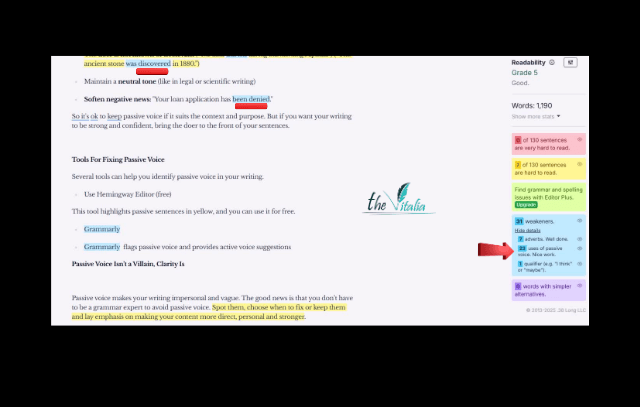
Several tools can help you identify and fix passive voice in your writing.
- Hemingway Editor. This tool highlights passive sentences in blue, and you can use it for free.
- Grammarly. Grammarly flags passive voice and provides active voice suggestions
Check out these top writing tools for content creators.
Passive Voice Isn’t a Villain, Clarity Is
Passive voice makes your writing impersonal and vague. The good news is that you don’t have to be a grammar expert to avoid passive voice in writing.
Spot them, choose when to fix or keep them and lay emphasis on making your content more direct, personal and stronger.
Do you often find yourself using the passive voice? Try rewriting a few of your old pieces of content and share the changes you observe.


Leave a comment