
Do your words make sense in your head but become a mess when you write them out?
Perhaps one sentence makes sense, but the following one seems disconnected and so doesn’t flow well.
It could be lacking transitions. These are words that help connect your ideas together, wether within a sentence, or paragraph.
Transition words include phrases or words like “in addition”, “as a result”, or “for instance”.
Without them, your content will sound unrelated and incoherent.
In this post, we will reveal the art of transition. We will break down what they are, their types, and share tips to improve the flow of your writing.
Also Read: Common Writing Wistakes
Summary
- What is The Purpose of Transitions?
- Categories of Transition
- Common Transition Mistakes
- Conclusion
What is The Purpose of Transitions?
Transitions link your ideas, sentences, paragraphs, and sections to ensure a logical flow.
Here’s what transitions do
- Guide your Audience: Help them follow your line of thought, showing them where your message is headed.
- Builds Momentum: Hooks and keeps readers engaged, aids comprehension, and reduces mental effort.
- More Professional: Transitions also make your content more professional and polished.
- Improve Readability and SEO: Using the right transition words makes your message easier to understand, and transitions also enhance the visibility of your content.
Related Post: 10 Simple Strategies to Improve Readability
Before and After Adding Transition
Let’s consider these sentences:
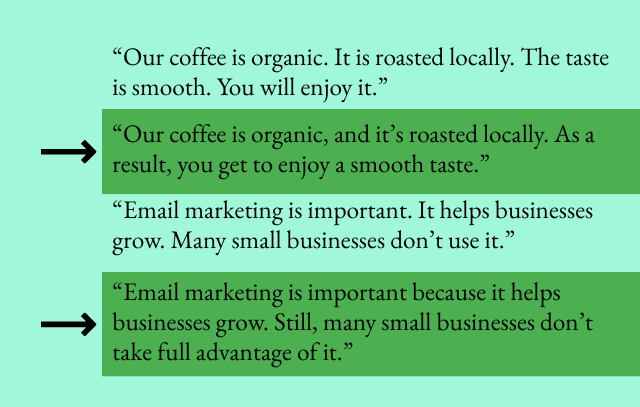
See how the sentences without transition break off, even though the following sentence is a continuation.
Categories of Transition
There are different types of transitions, and understanding the difference helps you know which to use.
1. For Adding Ideas
Examples: Furthermore, also, in addition
These are used to include ideas following a new sentence.
- “We bake gluten-free muffins. In addition, we offer dairy-free brownies for those with special diets.”
- “This app saves time on scheduling. Moreover, it helps in tracking productivity in real time.”
2. Contrasting
Examples: Yet, nevertheless, in contrast
Contrasting transition shows the stack difference you want to portray
- “I work remotely, and I love it. However, it can be lonely sometimes.”
- “Our ad campaign brought in a lot of traffic. On the other hand, only a few converted into customers.”
3. Cause and Effect
Examples: and so, due to, because of this
These show the chain reaction of an event and the consequences.
- “I forgot my umbrella at home. As a result, I got completely drained on the way to work.”
- “Our client response time improved tremendously. Therefore, our customer satisfaction ratings went up.”
4. Sequencing
Examples: first, next, finally, ultimately
Sequencing simply orders your message, making it easy for readers to follow from start to end.
- “First, I brewed coffee. Then, I packed my lunch, and finally, I left for work.”
- “First, define your target audience. Next, craft a simple offer and lastly, launch your campaign.”
5. Echo Words
These repeat a word for better flow. Echo words subtly link ideas or sentences by repeating a word that takes focus back to an earlier idea, helping to avoid jumping ideas.
- “Our sales peaked in Q3. That Q3 force moved us into a record-breaking Q4.”
6. Summary + Shift
This transition summarizes a point and smoothly moves on to the next idea. i
- “After simplifying the process, we saved hours. This swiftness allowed us to focus on innovation.”
7. Question bridges
Here, you end with a question, and then the answer follows.
- “So, how do you answer your audience’s pain point? The answer lies in their comments and feedback.
8. Visual Cues

Unlike typical words, these include emojis and line breaks.
Visual cues are mostly used in social media; they provide a path for your audience, guiding them through the screen.
9. Structural Transitions
These are actually formatting tools that make your content easy to scan.
They include lists and subheadings that break up large blocks into more manageable pieces.
No Structural Transitions:
Getting 10,000 email subscribers within six months is tough, but achievable.
The trick is to create a valuable lead magnet, such as a free e-book or checklist, in exchange for their email address.
Next, promote your free eBook or checklist on your social media pages to increase visibility.
Lastly, create a dedicated landing page, or consider adding pop-ups to your website to capture more emails.
With Structural Transitions:
Achieving 10,000 email subscribers within six months is feasible. Here’s what you need to do:
- Create a valuable lead magnet. Provide a useful free e-book or a checklist in exchange for their email address.
- Promote your lead magnet. Increase awareness of your free ebook or checklist by promoting it on your social media pages for greater reach.
- Maximize your site. Create a dedicated landing page or consider adding pop-ups to your website to capture more email addresses.
10. Pacing Transitions
This transition helps you control the speed of your message and, subsequently, the reading.
Here, you’ll use fast and concise words like “so”, “then”, or “immediately” to transition from one sentence to another quickly.
Meanwhile, if you want to slow down your writing pace, transitions like “as a result of that” or “which propelled us to” prompt readers to reflect and pause.
- Fast-paced: The first car wash campaign failed. So, we quickly launched a better one.
- Slow: The first car wash campaign failed, which compelled us to re-study our target audience completely.
Don’t miss our detailed post on editing tips to polish your content.
Common Transition Mistakes
Is it enough to just add words like “also”, “consequently”, or “moreover”, you might ask?
There is a right and wrong way to use transition words.
Here are the common mistakes people make in using these words.
1. Shifting Abruptly Between Ideas
It’s not unusual to jump from one idea to another as you type or dictate.
However, this can break immersion and confuse your audience, which can make them lose interest.
The correct transition words signal a change of ideas, which easily takes your audience along.
When editing, always check if a sentence or paragraph connects to the one before and the next.
When there’s a shift in perspective or idea, is it signaled clearly?
2. Using the Same Transition Repeatedly
Variety is the spice of life; this apparently also applies to writing and transitions.
Using the exact transition words can bore your audience and make your content look unrefined.
It also makes your writing very predictable and monotonous.
But you don’t have to have a mental transition library. A transition toolkit that categorizes common transition words can help.
This cheat sheet provides a comprehensive list of words for various uses and contexts.
3. Unnecessary Transitions or Overloading
While transitions make your writing flow, they should flow naturally and shouldn’t be forced.
This can happen when you use transitions unnecessarily. It disrupts the flow of your writing rather than enhancing it, making it awkward.
Use transitions only when necessary and helpful.
See this Example:
- Our meeting ended earlier than planned. Due to this, we had ample time to brainstorm.
- Our meeting ended early, giving us more time to brainstorm.
The last sentence flows naturally, unlike the first, with unnecessary “due to this”. Good transitions are not noticeable even though they enhance the flow.
In case you missed it: How to Write a Good Outline For Your Content
Conclusion
Transitions aid comprehension, prevent confusion, and help maintain momentum.
Whether you’re adding ideas, sequencing, or comparing, use them to improve your content flow.
Write your draft without worrying about
transitions, then edit specifically for flow. Highlight transitions in a second pass to ensure variety and necessity.
However, don’t worry about transitions when you write; you can add them as you edit your drafts.
Before you publish your next writing, check the transitions it contains and their purpose.

Leave a comment